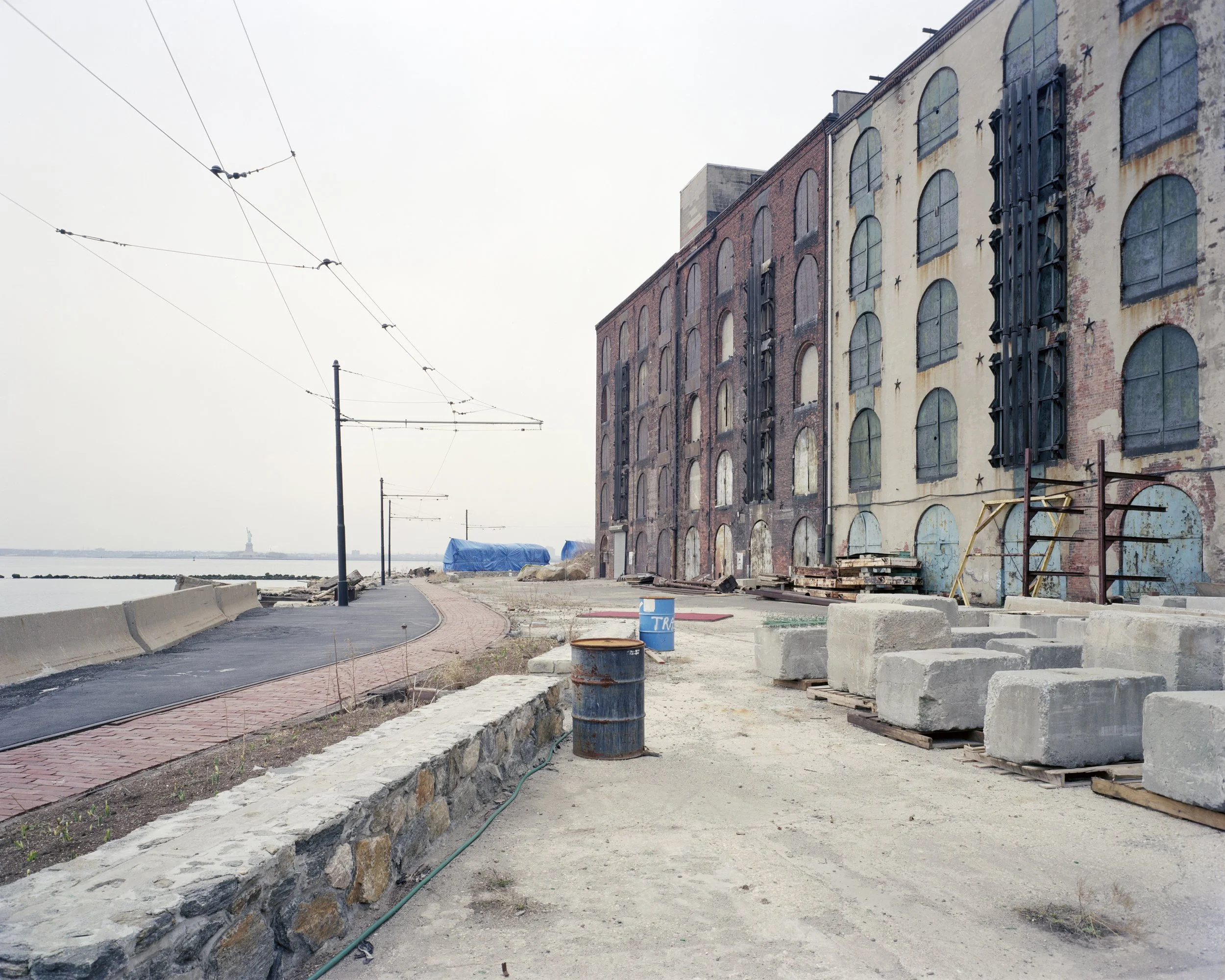
South Brooklyn
Brooklyn, New York 1999 - 2025
South Brooklyn is my home. For decades, I have returned to its streets with my camera, drawn to the built environment, the unprogrammed margins of the city, and the textures of the everyday and the political. These photographs map a landscape in constant flux—where industry gives way to vacancy, vacancy to gentrification, and memory slowly fades.
This body of work is both a record of South Brooklyn’s changing face and a personal archive. The images carry the weight of longing and desire, of memory and loss. They are meditations on place and belonging, on the slow violence and quiet beauty that shape the urban fabric over time. What emerges is both a portrait of a neighborhood and a self-portrait, inseparable from the histories that have passed through and stayed with me.
Introduction
“What are you doing here?”
The question follows me into dead ends, underpasses, loading docks, and the forgotten seams of the South Brooklyn landscape. Sometimes it’s asked with curiosity, sometimes with suspicion—but always with the quiet weight of assumption. It’s never just about the camera. It’s about the body holding it: mine. A visibly brown, visibly Arab man standing still in places where most people hurry past or avert their eyes. The camera doesn’t neutralize me or grant anonymity. In these spaces, it often marks me as something other—a presence that doesn’t quite belong.
I don’t photograph landmarks or glossy skylines. I walk the edges: service roads, industrial lots, fenced-off corridors where infrastructure lives and breathes. These are landscapes not meant to be seen, let alone lingered in. Yet this is where I feel most at home.
I photograph the margins from the margin—not just geographically, but personally. I grew up between countries, between languages, between definitions of home. My relationship to space has always been conditional, and that condition shapes my eye. What I frame, how I move, where I stop—none of it is casual. This isn’t a visual style. It’s a form of survival.
In America, the built environment reflects a logic of control. Space is never neutral. Sidewalks, overpasses, fences, and barriers carry histories of zoning, redlining, displacement, and containment. The racialized landscape doesn’t always announce itself; sometimes it simply sits quietly, enforcing limits.
I document these spaces not to aestheticize neglect, but to expose design. A closed gate. A dead-end street. A stairway to nowhere. These are not ruins—they are records of who was meant to pass through and who was meant to disappear. I move through them slowly, knowing that my presence—brown, alone, with a camera—is already a kind of disturbance.
Urban landscape photography often aspires to objectivity: a clean eye, a distant stance, a depopulated frame. My work resists that erasure. Even when I am not visible, I am felt. Sometimes my reflection enters the image, or a long shadow cuts across the frame. These are not accidents. They are reminders. The racialized body is never separate from the terrain it moves through. The image is not just what I see—it is how I am seen while seeing.
Being visibly brown in the field means every act of observation is reciprocal. The landscape looks back.
The margins hold power—not only in what they reveal, but in how they persist. There is dignity in patched fences, makeshift shade structures, repurposed containers; in small acts of use and reuse; in the way spaces adapt to those displaced elsewhere. These places are rarely considered worthy of documentation, yet they are full of quiet resilience. Not beautiful in the traditional sense—but insistent. Alive.
I don’t photograph them to mourn what’s been lost. I photograph to acknowledge what remains. What resists. What remembers.
For me, the photograph is more than a document. It is a repository for emotion—a structure that holds memory. Sometimes I photograph a space because it echoes growing up slightly out of place. Sometimes the geometry of a fence mirrors the feeling of being watched. Sometimes the emptiness carries an inherited grief I have yet to name. Images can hold what language can’t: tension, displacement, and the weight of history rendered in light and line.
To photograph this landscape—shaped by race, class, migration, and neglect—while being visibly brown within it is to occupy a fragile, powerful tension. I am both subject and observer, included and excluded. My looking is political. My stillness is a question. The camera gives me distance, but never detachment.
- Anthony Hamboussi, 2024