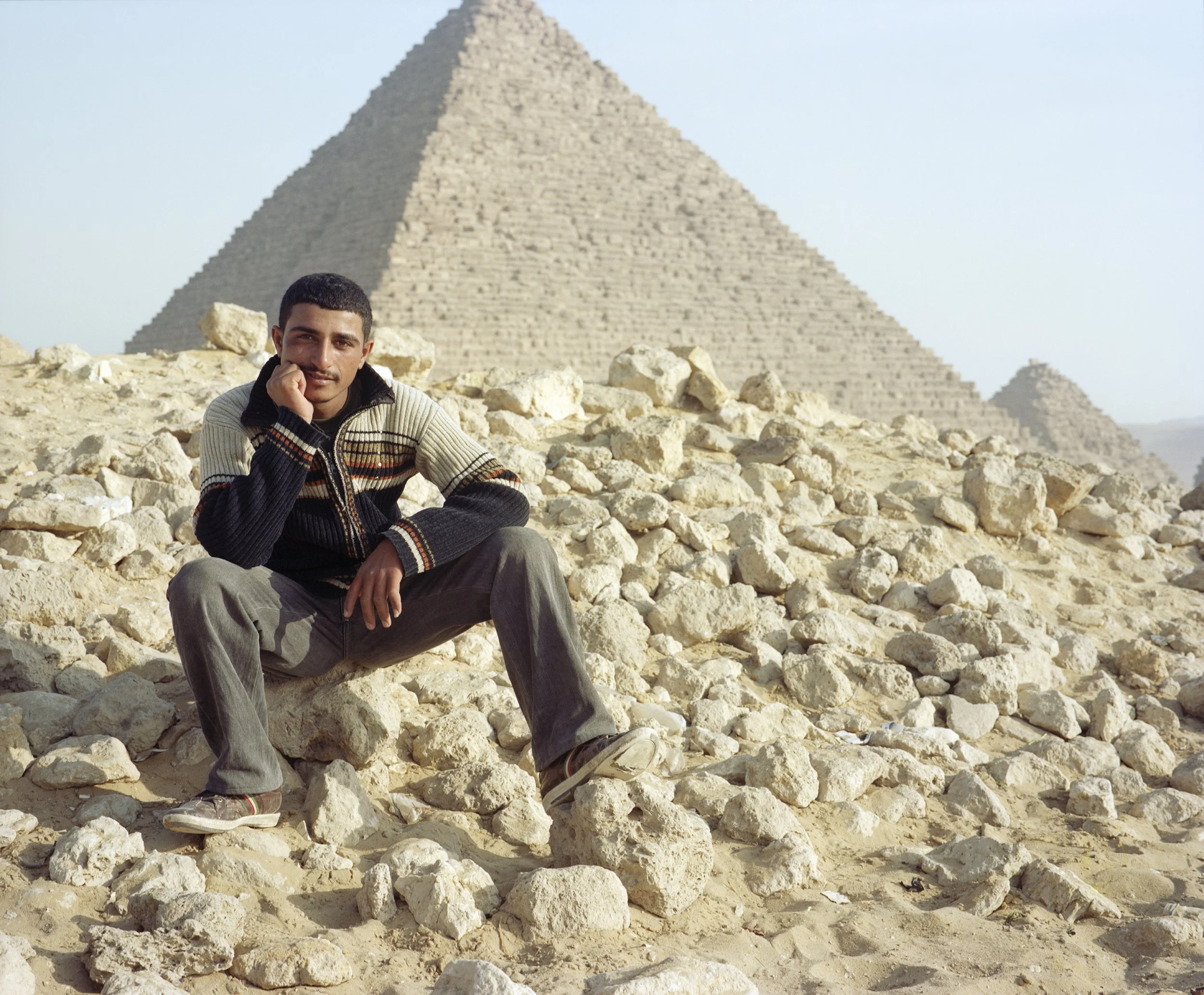
Cairo Dream
Egypt, 2009 - 2016
View Photographs
As a documentary photographer I pose questions about my relationship to the world and my place behind the camera. Am I protagonist or spectator? Having lived through relatively profound social change since September 11th, onwards, the possibility of being an objective observer is a concept which I now think of as antiquated. Held by an older generation of Western photographers this idea has been challenged time and again, yet it remains.
I was born in Brooklyn New York to working class Egyptian parents in the last week of 1969. When I began photographing in Cairo, my intention was to reclaim my identity as an Egyptian and to engage in a dialog about the environmental conditions that make up the city of Cairo. I set down my camera in public space imagining that I too could be objective. I was led to question my “American” way of thinking by events unfolding around me: a revolution, a military coup, and also, by the ways and generosity of everyday people.
I came to understand that the social implications of photography are very different in Egypt than in the US. In the US, many documentary photographers make photographs in ways which can be invasive or insensitive to others, because they believe it’s their right as individuals to do so. This way of thinking doesn’t hold a lot of water for Egyptians. Responsibility to one’s community over oneself is something I learned in Egypt.
I am considered an outsider in both countries I belong to. I’ve been stopped, detained and arrested while photographing in both countries and labeled an enemy in both countries; terrorist in the US, foreign spy or agitator in Egypt. The work of making the larger body of photographs which includes Cairo Dream, contains the duality of my insider and outsider identity. This identity keeps me one step in and one step out.
I have a process and framework: my large format camera and landscape. My first investigations began from my window. I was living in Masr El Gedida in 2009 - a middle to upper middle class area. I moved around, spoke with people and tried to immerse myself within the surroundings. I also visited and photographed sites of antiquities, churches and mosques, the busy downtown district of Tahrir.
It wasn’t until I left the city to visit my cousins in a suburb south of Cairo that I felt the lure of my subject. These under privileged districts resonated with me, they reminded me of the neighborhoods of my youth in Brooklyn. I found myself taking trips into these districts and wandering around, trying to fit in, which felt impossible. At first I walked around without a camera. Then with a point and shoot digital camera. Most people thought that I worked for a real estate developer or government agency and that I was scouting the land that they would be forcefully removed from. (This is a common occurrence).
At the same time I was doing these wanderings around the city, I began researching any texts I could find on the subject of the informal housing districts. I spoke with historians, architects, artists, and of course the residents. One day I went to visit my father’s old house, in El Matareya, and it reinforced the idea and commitment of community over individualism. The residents there remembered my father quite well after forty five years. I wound up having lunch for hours and making new relationships with people who welcomed me for no other reason than honoring my family name.
In 2010, back in New York, I showed a series of images made in Cairo in a group show called Ecoaesthetic: The Tragedy of Beauty. The show helped me think of my responsibility to the environment but this work felt more personal than just the aesthetics of environmental disaster. Then the 25 January Revolution broke out in 2011.
After eighteen days of protests, Egypt’s President of forty years stepped down and the moment was euphoric. Egyptians in Cairo and the diaspora felt a renewed sense of potential - one free of corrupt leaders. This was all naive in retrospect, but it was a beautiful moment in time. I moved to Cairo one month after the revolution began and made photos with a huge sense of urgency. I felt that the world was watching Egypt and my work could be a part of helping to bring awareness, create dialog and ultimately the social and economic change needed by the poor and working class. There was so much optimism at the time - Egypt was rising. Many felt a renewed sense of value and dignity, a bright and promising future.
This feeling was short lived. Censorship returned strongly, revolutionaries were incarcerated, tortured and more. Soon after, I had my first arrest. Afraid of what could continue to happen, I left Egypt at the end of 2011. But I had a very hard time consoling myself - I had the privilege to leave - most did not. When I was back in New York I put the work into boxes and decided to abandon the photographs. I felt that I had no right to show these images - to exploit the suffering of the Egyptian people. For a year and a half I did not look at these images.
In 2013 I applied and received a travel study grant from the Jerome Foundation. I applied with the proposal of studying Christianity in Egypt. My roots in Egypt are Christian. After returning to Egypt in December of 2013, I found myself drawn to the same subject as before. This time around I met so many activists and others, including my wife, who were deeply affected by the current situation and I took in a whole new perspective.
My project was resurrected. This time I photographed with a handheld film camera. I immersed myself in the work and watched the political situation get worse. People disappeared, were made suspicious of one another, were pushed to their edges. In a short period of time, the revolution would be removed from classrooms and history books. I was detained and arrested a second time. I was actually intimidated and shaken to the point that I haven’t made another photograph on Cairo’s streets since.
- Anthony Hamboussi, Brooklyn, 2016