Look Inside America
2001 / 2018 - 2024
View Photographs
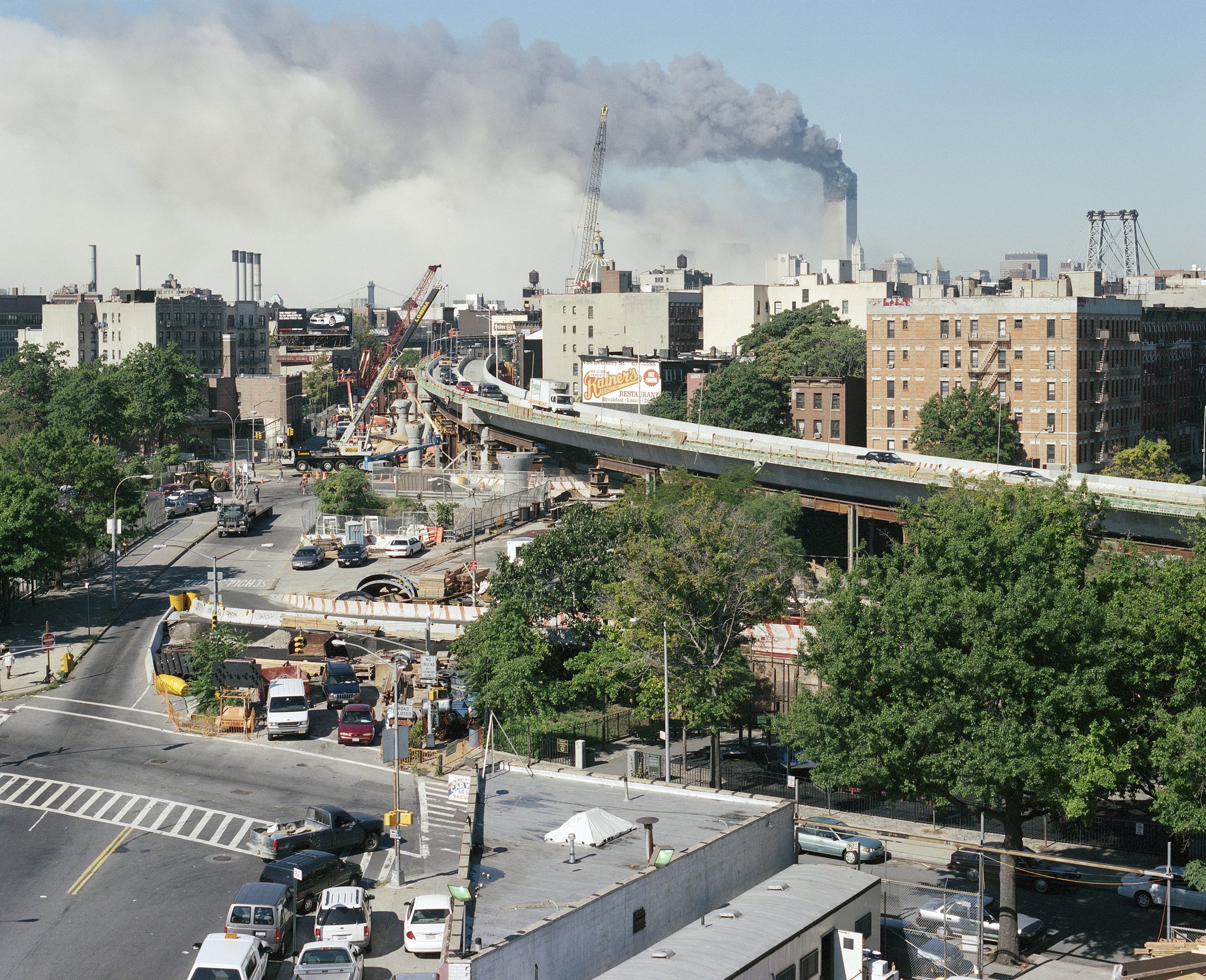
There is a photograph I keep returning to—an image I made on September 11, 2001.
From my rooftop in Williamsburg, Brooklyn, I watched the North Tower burn against a blue sky. When the tower fell, pigeons from my rooftop coop scattered into the air—white wings flashing against the smoke. I pressed the shutter again and again, not realizing that I was recording the beginning of a new era, and the end of another.
In those first days, the city felt fragile, bound by shock and grief. Strangers spoke softly to one another. But soon, the tone changed. The flags multiplied. The fear took shape. My parents called from Bay Ridge—an Arab neighborhood not far away—asking if I could bring them a flag to hang outside their home. It wasn’t pride. It was protection. A signal: We belong. Don’t come for us.
That was the moment I began to understand what it meant to be Arab in America. Belonging here was never unconditional. It could always be revoked.
A few days later, I was commissioned by SOMA Magazine to photograph how New Yorkers were responding to the attacks. On the streets, I encountered the full spectrum of emotion: grief, confusion, solidarity, and fury. Some wanted to understand. Others wanted vengeance. One man told me, “We should wipe the Middle East off the map.”
That was when my political awakening began—not in theory, but in survival. What began as a defense of my own civil rights became a confrontation with the deeper truth of how this country defines threat and belonging.
At the time, I was working regularly for The New York Times, Wired, Fortune, Newsweek—a freelance photographer represented by a photo agency, an NYPD press pass, and a steady career. None of that protected me. In 2002, while photographing a landscape near a Midtown Tunnel ventilation building in Queens, I was stopped by police. “If you see something, say something” had become the national mantra. I showed my credentials. They called my editors. I waited hours for the FBI. One agent asked, “Isn’t it strange that an Arab man would photograph infrastructure?”
After that day, the calls stopped. Editors didn’t return messages. My name became quietly unspoken. I had been blacklisted—not officially, but effectively. Around the same time, my cousin was deported under the Patriot Act. As a teenager, he’d served time for a drug conviction. After 9/11, that record became a life sentence. He was arrested again, held without charges for five years, and then expelled to Egypt—a country he had left as an infant. He didn’t speak Arabic. He missed his father’s funeral, his brother’s wedding, his grandmother’s passing. He was erased from the country he called home.
Look Inside America is my response to that erasure. It is a record of what lies beneath the surface of this nation’s self-image—a portrait of empire seen from within. Every photograph in this work is a question: What does freedom look like when built on exclusion? Who gets to belong? Who is made visible, and who is erased?
I have spent over three decades photographing the American landscape—the roadways and alleyways, fenced borders, industrial and mining sites, housing projects and forgotten peripheries. Each image traces the contradictions of a country that builds monuments to liberty while policing its shadows.
The smoldering towers of that September morning showed us, not only the nation’s grief, but its capacity for denial. The fear that followed—of the foreigner, the immigrant, the Arab—was not new. It was inherited. It had simply been waiting for permission to speak again.
Today, as bombs fall on Gaza financed by American aid, that inheritance is visible once more. The language of “security” is recycled, the hierarchies of whose lives matter remain intact. The same blindness that saw me as a suspect now sees entire peoples as expendable.
- Anthony Hamboussi, 2023