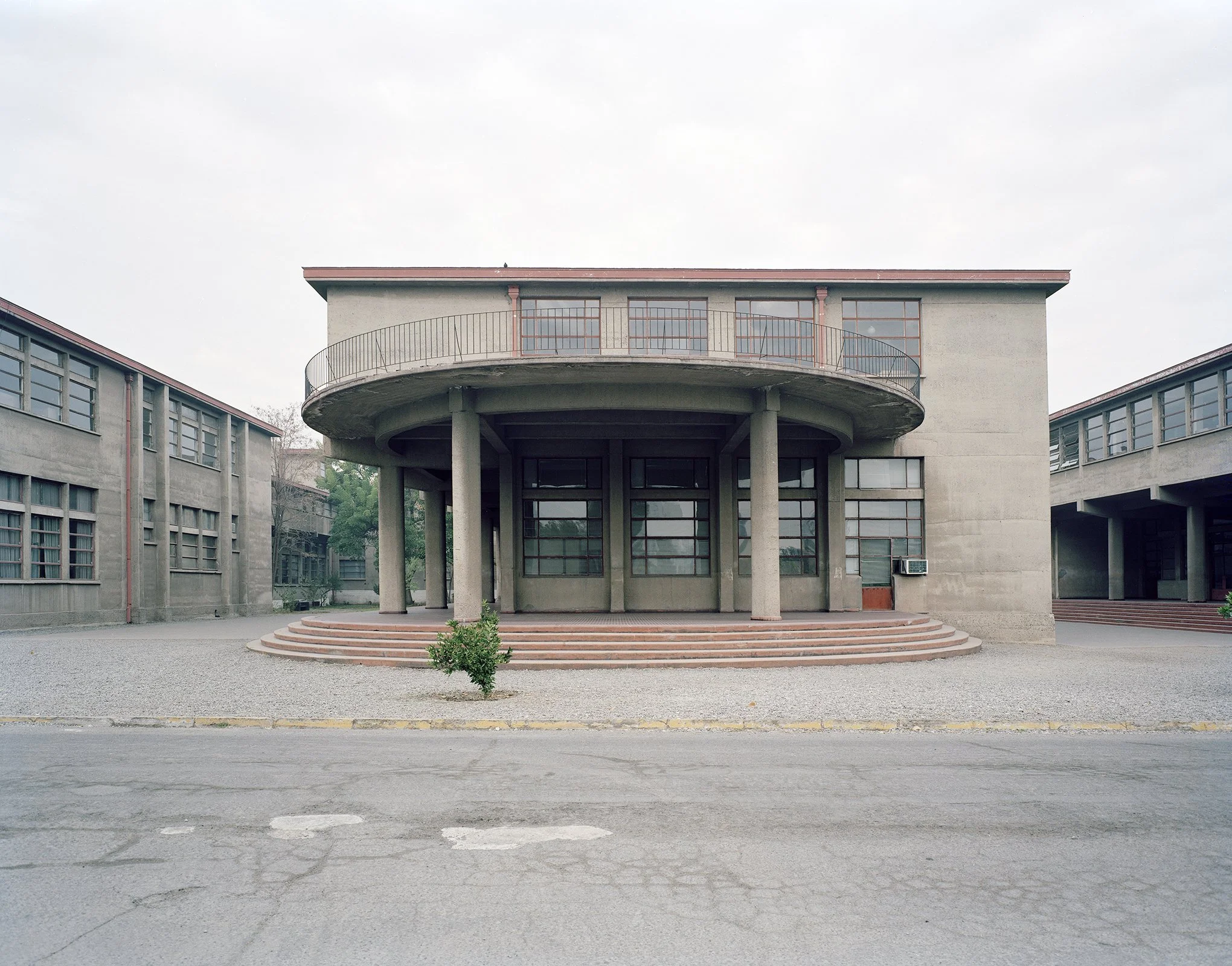
Las Condes

Santiago, Chile, 2007

In 2007, Anthony Hamboussi undertook a meticulous photographic survey of Las Condes, the affluent eastern commune of Santiago, Chile, using a large-format film camera. Continuing the investigative and site-specific approach seen in his earlier projects—Newtown Creek (New York) and La Petite Ceinture (Paris)—Hamboussi’s work explores the tensions between urban expansion, socio-economic stratification, and the enduring traces of historical and institutional presence within the built environment.

Las Condes captures a city in transformation. Once semi-rural and composed of sprawling estates, the commune had by 2007 become a dense and high-income enclave, mixing luxury residential neighborhoods with commercial towers and corporate office buildings along major thoroughfares such as Apoquindo Avenue. The photographic series documents the duality of this landscape: the modern infrastructure of transit-oriented developments around the Escuela Militar metro station, juxtaposed against the historical presence of the Escuela Militar del Libertador Bernardo O’Higgins, which continues to anchor a portion of the urban fabric, and the Observatorio Astronómico Nacional atop Cerro Calán, a scientific outpost caught between Santiago’s urban sprawl and the preservation of natural terrain.

Hamboussi’s large-format methodology allows for precise, deliberate framing, emphasizing both the monumental scale of new construction and the residual traces of older structures and landscapes. The series investigates how wealth and urban planning shape the physical environment, documenting Las Condes as a site where high-income aspirations, institutional legacies, and rapid urban densification intersect.

Echoing Hamboussi’s broader practice, the work maps the socio-spatial narratives embedded in the city—the collision of past and present, rural and urban, institutional and commercial, natural and constructed. Las Condes is a visual exploration of a city negotiating its identity amid economic prosperity, infrastructural expansion, and the pressures of metropolitan growth.