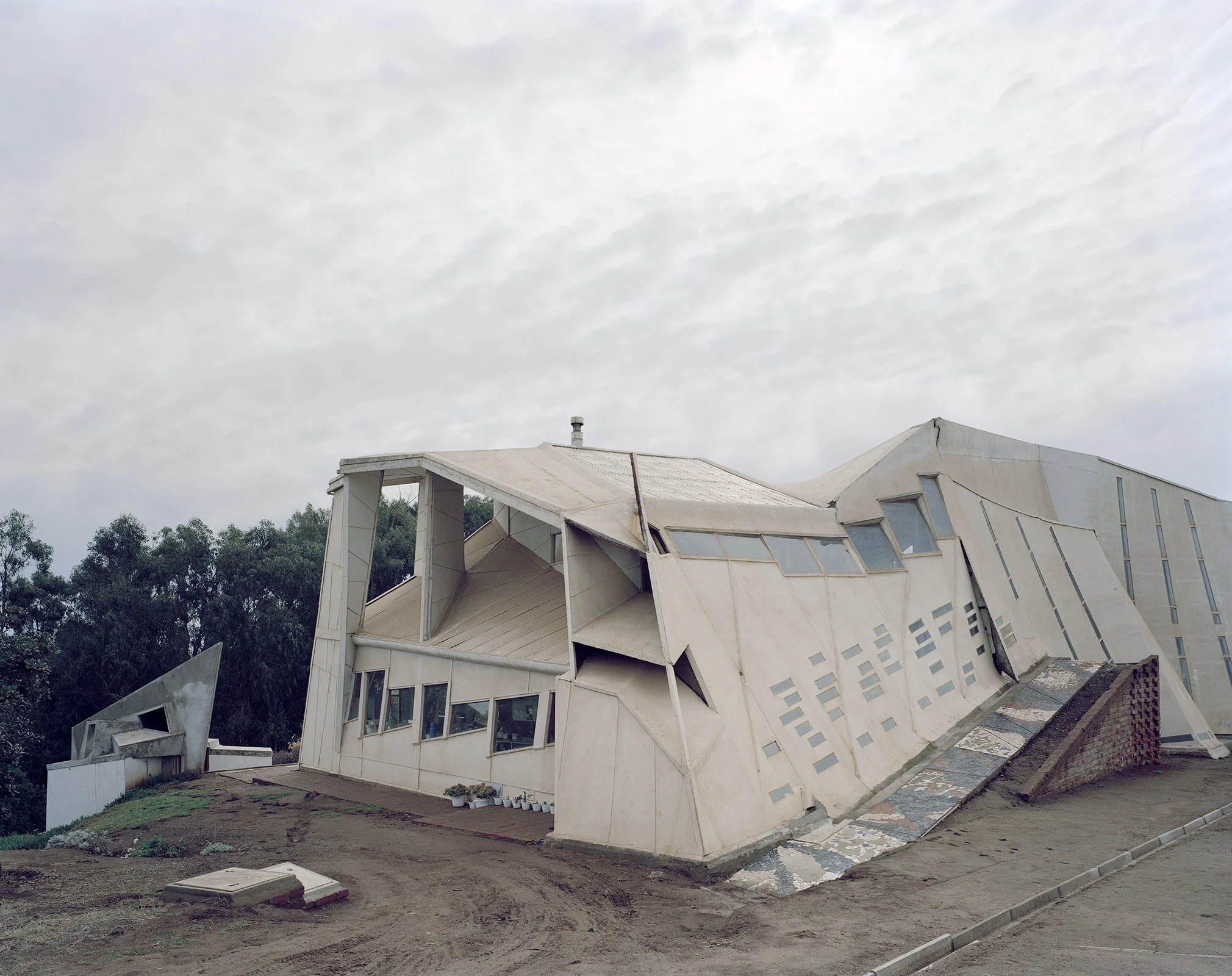
Ciudad Abierta  (Open City)

Ritoque, Chile, 2001 - 2007


Anthony Hamboussi’s photographs of Ciudad Abierta are much more than a visual record of an architectural settlement along the Chilean coast. Seen in the context of the site’s history and philosophy, the images become evidence of a rare cultural experiment: a place where architecture, poetry, and landscape merge into a single, living project.

Ciudad Abierta was founded in the early 1970s by a collective of architects, artists, and poets from the School of Architecture at the Universidad Católica de Valparaíso. Their aim was not simply to design buildings, but to explore an entirely different way of inhabiting the world. As a “city” built within dunes, ravines, and shifting coastal light, its structures were created collectively by students and faculty, guided by acts of poetry, improvisation, and respectful engagement with the land.

Hamboussi approaches the site as both documentarian and interpreter. His photographs place equal weight on the architecture and the territory that contains it: dunes folding around wooden dwellings, concrete forms anchored against vast horizons, fragile structures holding their ground against wind, and sand. In doing so, he reveals how each building in Ciudad Abierta is inseparable from its environment. The photographs make visible the dialogue between the constructed and the natural—one of the founding intentions of the Open City.

Because Ciudad Abierta rejects traditional urban planning, the resulting built works appear scattered, provisional, sometimes isolated. Hamboussi’s compositions emphasize this sense of openness: buildings sit lightly on the land, sometimes barely interrupting it. Empty spaces and long distances become as important as the structures themselves. His images capture the silence of the place, the absence of the typical markers of a city, and the presence of something more elusive—a community defined not by density or commerce, but by ritual, collaboration, and poetic intention.

Ultimately, Hamboussi’s work underscores the spirit of Ciudad Abierta as a living poem—an evolving landscape shaped by imagination, community, and the elemental forces of wind, sand, and sea. His photographs hold the tension between utopia and reality: the idealism that founded the Open City, and the material traces of decades of experimentation. Through this lens, Ciudad Abierta emerges not just as an architectural site but as a continuing gesture—a testament to the idea that how we inhabit the world can itself be an act of art.