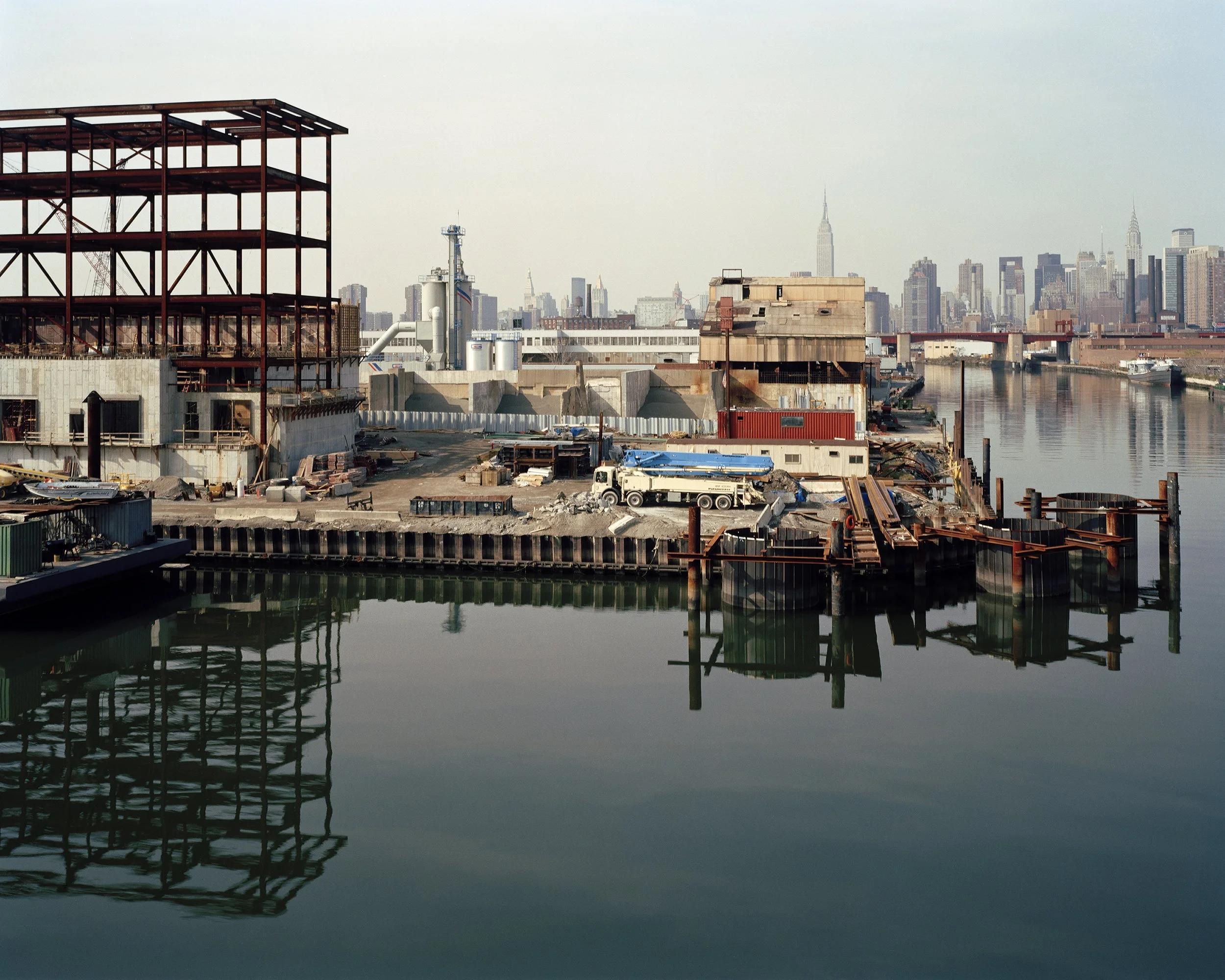
Newtown Creek

Brooklyn/Queens, New York, 2001 - 2006


Newtown Creek is a photographic survey of an industrial waterway, which focuses on changes to the landscape and built environment, along the creek and its surrounding area, over a five year period. The survey captures the waterway at an in-between moment in time when industry and manufacturing have disappeared and gentrification and development are beginning to transform the area.

Afterword

by Bernard Yenelouis

Who owns the world? And how? Are we a part of it or are we onlookers? Is it a spectacle or should it be ignored? Are there spaces to forget as well as those to acknowledge? And who decides that?

Anthony Hamboussi’s documentation of the Newtown Creek, an industrial canal in New York City that demarcates a formerly natural boundary between the boroughs of Brooklyn and Queens, entertains these and similar questions. The Newtown Creek, while prominent on any map of New York City, is a space almost invisible otherwise. Its name is not commonly known.  It is an area to transverse to get to somewhere else.  It is between things.

Official archives assume the structure of the needs of some sort of State or governing body: what is important to measure is clear, what is superfluous can be overlooked. Hamboussi’s project is independent of any official jurisdiction, and as such follows a methodology that incorporates non-objective aspects such as intuition and memory in his execution of the work. This was a descent into a no man’s land, seemingly devoid of historical or picturesque value. In fact, Hamboussi was repeatedly visited by officers of the Metropolitan Transportation Authority and the New York City Police Department during the execution of his work, which indicates that as forgotten and overlooked as this landscape may be, it is nevertheless of some value to a controlling state. Both governmental and private interests own the land. Its status as a peripheral urban space notwithstanding, the Newtown Creek nevertheless, like a cog in a machine, enacts specific economic destinies with invisible vitality and, it is assumed, prosperity.

Readers of F. Scott Fitzgerald’s novel The Great Gatsby may recognize the Newtown Creek as part of what is described in the novel as the “Zone.” The Zone is a desolate area that exists between the splendors of rich (pre-Depression, pre-income tax) Manhattan and the even more chic and exclusive country mansions of the North Shore of Long Island. The wealthy protagonists travel through the Zone, making it a pit stop for gasoline and sex. The unreality of great wealth is contrasted with the base survival of those less fortunate, and also where Gatsby and the Buchanans enact primal drives of love and death. It is an immersion in the mire of the world, which is seemingly unconnected to the characters’ lives otherwise, but which in its reductive full-blooded yet shabby atmosphere, devoid of social niceties, is the unconscious behind their sleek chic.

The Newtown Creek is also a site of entrepreneurial abandon: land that is exploited and used and becomes invisible as such. The warehouses, the factories, the plants all exist in a socially invisible form—they are off the beaten path, out of sight, out-of-the-way. How the area changes (and it does, constantly) is irrelevant, as it has been marked off the map as a stagnant, industrial wasteland, seemingly in perpetuity. It has become a designated junk space—dirty, ugly, (seemingly) worthless. Like a dream, the panorama of the Oz-like towers of Manhattan gleam in silhouette to the west across the East River, while the locals step in soot and mud, above stagnant waters. Shiny splendor emanates across the river, in contrast to the abject utilitarianism of the Creek. This is a mixed industrial-residential area, too. One area on the Queens side has the truly inappropriate name of “Blissville.” To reiterate a dialogue from Gertrude Stein’s The Mother of Us All: “What’s in a name? EVERYTHING!”

The Newtown Creek exists like a dirt stain on the map of New York City, and it is silenced as such. In fact, it is hardly known to people that don’t live in its proximity; yet despite its utter decrepitude, it is nevertheless an essential part of the city and an economically vibrant area. From Phelps Dodge to Fresh Direct, from National Grid to illegal dumping, the realities of an industrial and seemingly post-industrial society are within arm’s length. In his work Hamboussi proposes a phenomenological reading of the site as a kind of existential angst: As per Samuel Beckett, “I can’t go on, I’ll go on.” In Hamboussi’s images the utter frustration of such an abject environment does not negate their lived-in, quotidian aspect.

This is not a place where anyone goes, yet one can. One of the supreme ironies of the creek is that it gave its name to the first cultivated apple of the New World, the Newtown Pippin, first documented in 1759 by the then fertile shores of the creek. Such a dream of freshness and deliciousness belies the otherwise morguelike entropy of the current industrial parks, electrical towers, and gas tanks. Hamboussi’s project follows precedents such as the images by official photographers such as Charles Marville, hired by various Parisian civic offices to document the eventual destruction of medieval Paris and the implementation of Baron Haussmann’s mid-nineteenth century plans. Replacing the real with the photograph—the photograph becoming a surrogate and a form of memory—such official images seem to serve as a justification of the destruction of the actual site. Hamboussi also brings to mind more independent archivists such as Eugène Atget, who itemized both the great and ephemeral things of Paris, selling prints from a sidewalk stall, as “documents for artists” as he advertized them; as well as the rigorous work of German photographers Bernd and Hilla Becher, who created visual typologies of obsolescent industrial structures. Hamboussi’s photographs lack the relentless picturesque qualities of Atget’s, but he shares his predecessor’s appreciation of the commonplace as a site of interest. Unlike than the Bechers, Hamboussi does not create a rigorous conceptual visual structure for his photographs, but like them he shows an obsessive interest in a subject.

The sites Hamboussi photographed are researched rigorously in terms of ownership, boundaries, changes, with multiple histories of industrialization, development, and abandonment, back off from any overt statements or readings. Their histories are invisible. The photographs make apparent a contemporary physical result of these trajectories.

These are also studies of great solitude, akin to the paintings of Caspar David Friedrich; the Friedrich paintings show small figures facing out into great voids of beyond. Rather than the magnitudes of nature as a portal to eternity, what we see in the photographs instead is over a century of ruins and decrepitude, of varying tides of industry, urban infrastructure and governmental policies. The waxes and wanes of the economy become our landscape. The lone or small groups of figures in the Friedrich paintings become us, in such a setting.

Hamboussi’s attention to the peripheral, the liminal, proposes an understanding of our world in which the unheroic, the ordinary, the overlooked, exist as ciphers out of which an alternative map can be constructed. This is both tough and tender.

Backyard New York

by Paul Parkhill

At 7 AM on July 15, 2001, the Maspeth Holders—twin tanks that made up the North Brooklyn skyline—imploded in a planned demolition commissioned by Keyspan Energy Delivery. Although the implosions of the tanks, which had been built in 1927 and 1948 to ensure constant residential gas line pressure and, by 2001, had outlived their usefulness, strangely foreshadowed the fall of the World Trade Center two months later, for those of us watching at the time the event suggested nothing particularly apocalyptic. Rather, it served as a reminder of how rapidly urban landscapes can transform, and of the various ways neighborhoods and communities can become unrecognizable even to those most familiar with them. Among those documenting the fall of the tanks was Anthony Hamboussi, a photographer with a large-format camera and an obsession with urban landscapes. The implosions became the inspiration for Hamboussi’s five-year documentation of the Newtown Creek, the fruits of which became this book.

I met Hamboussi in 2003, when he showed up at my workplace, the Greenpoint Manufacturing and Design Center—a nonprofit that renovates industrial properties for small manufacturers—and inquired if he could get onto our roof. Our biggest building, at the end of Manhattan Avenue, offers one of the better vantage points onto the Newtown Creek. Hamboussi was one of the few people I’ve taken up to the roof who completely ignored the Manhattan skyline across the river in favor of the industrial sprawl of Brooklyn and Queens. Over the next couple years he returned to our building several times, typically drawn by meteorological conditions: I always started looking for him when a low sheet of clouds rolled in. I thought I knew a lot about the creek and its environs, but Hamboussi showed me otherwise; nothing escaped his notice: the ruins of Morgan Oil, an in situ black street sign from the 1920s, the dirt road oasis at the end of North Henry Street, the carefully tended green rock outside the Waste Management facility. Not only did he photograph these places, he researched them, evaluated them, and developed a theoretical framework for them. He’d wrestled with Jane Jacobs’s discussions of “border vacuums,” eventually rejecting the relevance of her observations to this particular set of landscapes. His knowledge and understanding of the physical and social dynamics of the creek greatly surpassed the typical perspective of the photographer, taking him deep into the realms of history, planning, and urban design.

Hamboussi’s interest in industrial waterfront landscapes dates back to his childhood in the 1970s. He grew up on a block just south of the Gowanus Canal, an area that even to this day is primarily the domain of sanitation garages. He spent years documenting graffiti and street art in the area. Newtown Creek, New York City’s liquid industrial spine, was thus a logical focus for his subsequent artistic pursuits.

On preliminary inspection, the sites documented in this book may suggest a dark, familiar scene in twenty-first-century America: a landscape of deindustrialized neglect and abandonment. Newtown Creek, an astoundingly polluted waterway between Brooklyn and Queens, is a terrain of capped Superfund sites, salt piles, sewage tanks, crumbling bulkheads, and smokeless smokestacks. Depending on when and where one arrives at the creek, the impression of neglect may be enhanced by a sense of municipal chaos and social dysfunction: homeless encampments in Long Island City, emaciated prostitutes in East Williamsburg, souped-up Civics drag racing in Greenpoint.

Having worked along the creek for about a decade, I can say with some conviction that any assumptions about abandonment are misplaced. Behind the street walls and cyclone fencing, inside the shuttered factories and warehouses, there exists a world hidden to the casual observer. The Newtown Creek reflects, in the words of one waterfront planning official, the “backyard” of New York City. Desolate in spots, disgusting in others, it is far from abandoned. The creek is one of several areas across the city that accommodates many of the uses that are critical to the functioning of an enormous metropolis—sewage treatment, waste transfer, scrap yards, tow pounds, warehousing, manufacturing, acres of heavy infrastructure. No longer the economic engine it was in the nineteenth century, the Newtown Creek nevertheless remains a critical part of New York’s complex urban machinery.

Like many modern backyard neighborhoods, the physical terrain and the current land use of the creek reflect a legacy of extraordinarily heavy industry. The  Newtown Creek was once the site of some of the more environmentally horrific processes ever invented, including tallow rendering, oil refining, copper and chemical manufacturing, and gas processing. It is the current site of the largest oil spill in North America. During the Industrial Revolution, when commercial shipping traffic on the Newtown Creek exceeded that of the Mississippi, the creek itself was transformed from a meandering tidal wetlands into a bulkheaded canal, largely with the aid of industrial fill. A significant part of the former Phelps Dodge site, for example, is built from slag produced from the copper manufacturing process.

Following a typical nineteenth-century urban development pattern, the neighborhoods around the Newtown Creek often housed those who worked in its factories. This mixed-use development pattern—the physical characteristics of which largely remain intact—played a critical role in establishing and sustaining blue-collar, immigrant-based neighborhoods that served as the starting point for new Americans aspiring to move into the middle class. While most of the heavy manufacturers are now gone, the industrial work that goes on around the creek these days continues to serve this function for new generations of immigrants.

The current decade has also seen a blossoming of interest in the future of Newtown Creek from a water quality and redevelopment perspective. The thirteen-year, $2.2 billion upgrade of the Newtown Creek Water Pollution Control Plant (a sewage treatment facility) is among the largest public works projects in New York City. In addition to new anaerobic digester eggs and other essentials, the project includes a Percent for Art initiative that has resulted in the construction of an incredible waterfront open space designed by artist George Trakas. A regional nonprofit called Riverkeeper has led the way in improving the creek’s overall water quality, performing extensive environmental monitoring and filing suit against Exxon/Mobile in 2003 to force the company to expedite the cleanup of the fifty-year-old oil spill. Currently, the Newtown Creek is also under consideration by the Environmental Protection Agency for designation as an underwater Superfund site. Finally, this year the Greenpoint Manufacturing and Design Center, the Newtown Creek Alliance, and Riverkeeper were awarded a large Brownfields Opportunities Area planning grant to analyze brownfield sites around the creek for redevelopment of new industrial uses and open space.

While neighborhood homogenization, overdevelopment, and the evisceration of New York’s middle class have become increasingly popular topics of conversation, the disappearance of urban backyards remains a somewhat obscure topic. The notion that any area can or should be protected from the speculative investment that drives “highest and best use” simply rubs against the grain in a developer-driven town. The five-year period documented here is one in which the Newtown Creek landscape just started to show a few external signs of the relentless, city-wide gentrification taking place all around it. At the mouth of the creek, large-scale rezonings in Greenpoint, Brooklyn and Long Island City, Queens, have resulted in speculative frenzies that have driven up the cost of land to the point where virtually anything but high-density, high-cost housing ceases to be viable. Further down the creek, these pressures are still less intense, but the paucity and price of land remains an inevitable pressure. The images in this work are organized chronologically, beginning in 2001 and ending in 2006, so that the reader can witness these sometimes subtle and sometimes dramatic changes in the landscape.

Paul Parkhill

Greenpoint Manufacturing and Design Center

August 2008